
powerless (Laeth)
book review

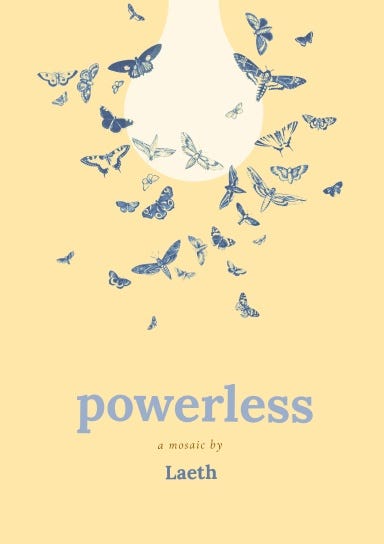
If in sketches of Alice Laeth began to stretch his wings, in powerless Laeth has begun to fly. This book was a breeze to read, immersive and rhythmic and flowing. I think it is his best to date, as he continues to get better, evolving with each book.
The book consists of ten semi-interlocking stories, set on the day of the Iberian peninsula blackout. Each is a love story; romantic love primarily, though also love of man and dog, of friend, and of Lisbon. Almost every character is something of a struggling artist, usually related to either jazz, writing, or movie-making. All the stories seem to emerge around the character of Alice (from Sketches of Alice), who is the gravitational center of the book.
Reading powerless what immediately stood out was how alive the characters were. Phantasia and The Rot were, in a way, less about characters and more about deeper currents of the world, and the narrator’s response to them through the telling of the story. In Sketches of Alice, the two main characters breathed in the page. And as the larger story of Alice has continued in powerless, it seems almost as if the characters are beginning to take over; as if they are revealing themselves and telling their stories through Laeth’s pen.
Two characters in particular stood out to me. The character of Diana, in the “three angles” story, who seemed to shimmy her way into the book as she did in the story itself; so full of life, popping off the page and sort of worming her way into my heart through her sheer charm. As I read the story I felt quite impressed that Laeth had found such a creature! And also the character of Edgar, in the “lights out” story, who was pathetic in a funny, yet compelling and deeply sympathetic way. (“lights out” is also my favorite story in the book.)
All the stories take place in Lisbon and its surroundings. Yet not once is either “Portugal” or “Lisbon” mentioned by name. There are many references to the Atlantic, the Tagus, the city’s seven hills, Olisipo, and the Lusitanian people (in a lecture from Alice herself). Lisbon is not mentioned by name almost as if its spell would be stronger if it’s name were not said; as if the true Portugal might not be seen if you allowed modern associations to cloud its characterization. A romantic Lisbon appears, the old world charm of the city weaving into the stories. Laeth is a Woody Allen fan, and he has done something of what Allen has done for NY, for Lisbon.
All of Laeth’s books to date have some metafictional element. In his first two (Phantasia and The Rot) this aspect was quite obvious, across the surface of the story. In Sketches of Alice the metafictional aspect was more subtle (I have an esoteric reading of the book here), but the tone of the narrator is serious for the most part, appropriate for such a sad book. In powerless, it feels like the narrator has become playful, that he is having fun and winking at us in several places. For instance, it is not always clear whether the story being told is what it appears on its face, or whether truth has been alloyed with fiction. The narrator says of one of the characters (or also of himself?) “He considered happy endings cheap, but was too much of a romantic to write unhappy ones, especially since his subject was his own love life.” And earlier a character talks about how he will later write a story about the day’s events, and that he will probably rewrite it so that it is a successful love story. We wonder: is the narrator dreaming of what he wishes happened, or is it the world as it is? And of course the whole novel itself has this character, as you read the final chapter.
The playfulness extends also to the styles of the stories/chapters, which vary. One is all dialogue. A couple are dissonant in places, such as a crowded field trip scene in “three angles,” where many kids and teacher (Alice) are talking almost on top of each other, with laethian dialogue that can be difficult to untangle and has an experimental feel. This can give you a headache if you try too hard to understand exactly what is happening as you read each line. But, if you relax and sort of walk through it, the buzzing effect it produces is interesting and appropriate to the situation, where anyway it doesn’t matter in that moment exactly who is talking. This is something more common in film and hard to achieve in writing, where Laeth is pushing the boundaries of the medium. But then later in the same chapter there is a three-way dialogue where each character’s voice has developed so uniquely that even without being told who is speaking you know immediately whether it is Alice, Diana, or Elsa. That is impressive. Whereas in earlier Laeth books more skill was required from the reader, in powerless Laeth seems to have begun to master the effect of his approach to dialogue, where most of it is crisp and polished, and dissonance is more selectively used to create interesting and musical possibilities that conventional forms of writing don’t allow.
This book is the most accessible introduction to Laeth’s work, but also the most artistically complete. A beautiful book. I loved it.
[buy the book on Lulu]
Your gift for writing (and thinking) comes out in your reviews. A great tribute to a great book.
Now perhaps a story of your own!